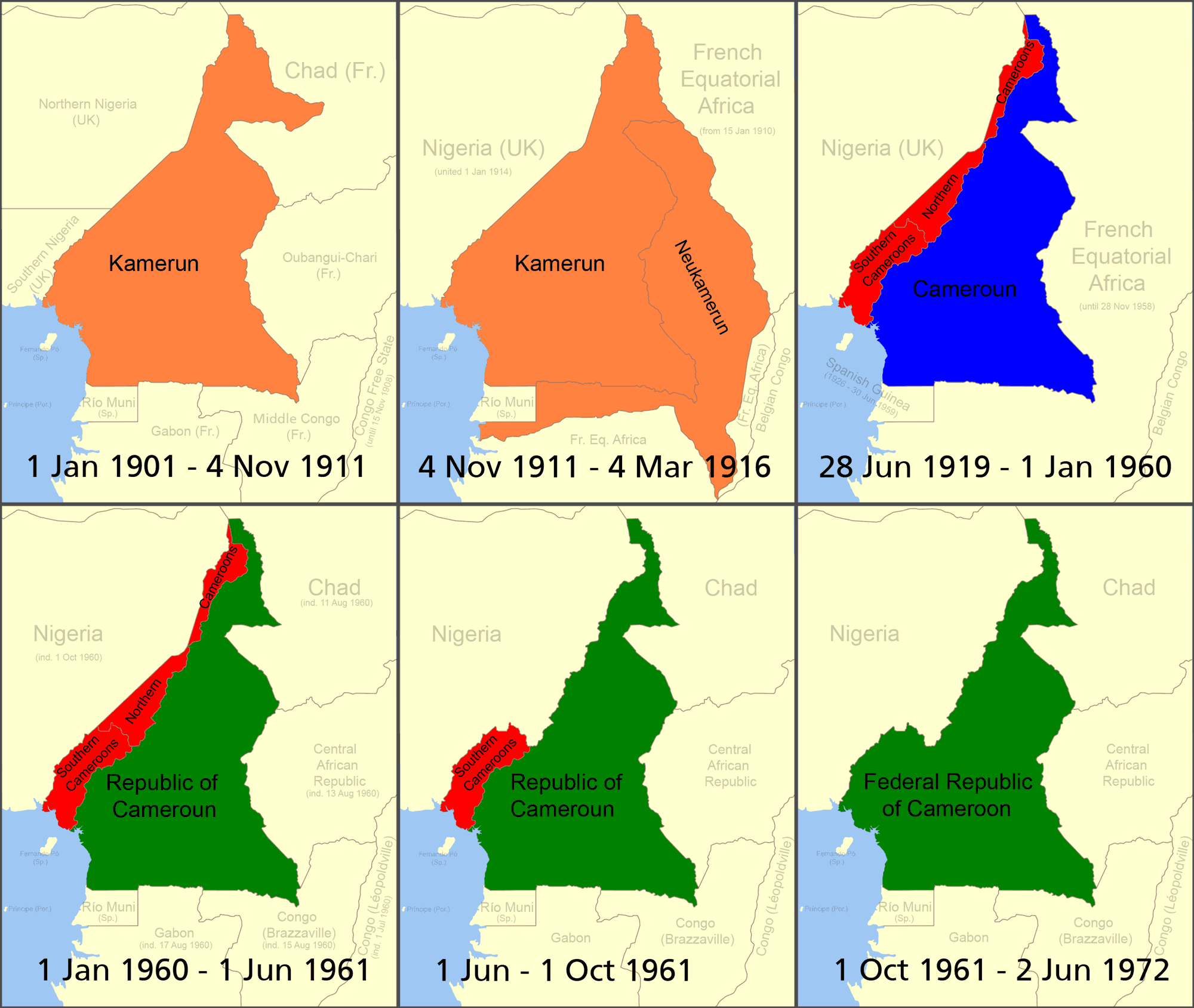
As indicated before, Cameroon's case is
unique...In the case of Quebec and Eritrea, they were incorporated into British
Canada and Ethiopia, respectively, as "trophies of war", hence they
could or can politely get out (through a plebiscite or referendum)---Quebec, or
fight their way out---Eritrea. Eritrea did just that with the support of the
new government of Ethiopia after the overthrow of Ethiopian dictator Mengistu
Haile Mariam. Britain simply brought South Sudan and Sudan together, two entities
that had no history before as a single geopolitical entity (polity); and it had to take decades of
war and millions of deaths for the international community, led by the United
States of America, that was against the Islamist regime of Omar Bashir, to
allow a referendum that allowed South Sudan to go its separate way. And of
course, Zanzibar was a British protectorate (a protectorate which, in modern
international law, is a dependent territory that has been granted local
autonomy and some independence while still retaining the sovereignty of a
greater sovereign state. The United Kingdom never granted independence to
Zanzibar because it never had sovereignty over Zanzibar. The UK simply ended
the Protectorate and made provision for full self-government in Zanzibar as an
independent country within the Commonwealth. It was the revolutionary
government that came to power in Zanzibar a month after Zanzibar's independence
by overthrowing the pro-British monarch that negotiated Zanzibar's union with
Tanganyika, thereby forming a new country called Tanzania. So, Zanzibar could
have stayed independent if it wanted to. Southern Cameroons never had that
option.
The case in Africa, which you could have even
compared to the British Southern Cameroons, was British Somaliland. Somalis,
who had never been united before, found their homeland even more divided into
three Somali colonial territories (French Somaliland, Italian Somaliland, and
British Somaliland) during the partition of Africa, and the rest as a part of
Kenya (North-east Kenya) and Ethiopia (Ogaden). Italian Somaliland became a
British Trust Territory, like British Cameroons (British Northern Cameroons and
British Southern Cameroons) after World War 2, which Britain administered
separately from its protectorate British Somaliland. The Legislative Council of
British Somaliland passed a resolution in April 1960 requesting independence
and union with the Trust Territory of Somaliland (the former Italian
Somaliland), which was scheduled to gain independence on 1 July 1960. The
leaders of British Somaliland and the former Italian Somaliland met and agreed
to form a unitary state. However, Britain ended its control over British
Somaliland five days before the scheduled unification date, so that the
territory was briefly independent as the State of Somaliland before uniting on
July 01, 1960, with the Trust Territory of Somaliland (the former Italian
Somaliland) to form the Somali Republic (Somalia).
Curiously enough, following the descent of
Somalia into a failed state in the aftermath of the civil war that followed the
1977-1978 war against Ethiopia in its bid to unite Ogaden with the rest of
Somalia, the exit from power of
President Siad Barre, and the breakdown
of the central government, a geopolitical entity emerged in May 1991, calling
itself the “Republic of Somaliland”, and regarding itself as the successor to
former British Somaliland as well as to the State of Somaliland (the
short-lived independent state of five days). Yet no country or international
organisation has recognised it until today. There is no need to delve deeper
into the Somalia quagmire. And there are
tons of other nominally independent states that are still unrecognized today
who sacrificed blood to secede from the dominant state they were a part
of---Nagorny Karabakh, Transnistria, Donetsk People’s Republic, Lugansk
People’s Republic, and until 2008 Abkhazia and South Ossetia (That Russia and a
few countries recognized following the Russo-Georgian war) and Kosovo
(recognized by many Western countries), but not by up to half of the world.
These entities have control of their territories, standing armies, government,
and other trappings, but are not recognised as such, hence are not connected to
the international financial systems, international trade, international legal
system, the United Nations, and its affiliated institutions, etc.
In a nutshell, the retarding establishment can
only address the grievances of
Cameroonians West of the Mungo piecemeal. But a true, fundamental,
genuine, and overall resolution of Cameroon’s No 1, minority problem is
possible only in a New Cameroon, a New Cameroon that is possible after all the
peoples of Cameroon, irrespective of religion, region, ethnicity, or linguistic
affiliation join hands and with all seriousness dismantle this French-imposed
system that has kept all Cameroonians in a cesspool for close to six decades.
And truth be told, I think the Northwest
region is the least conscious of that reality as its politicians confuse the
population into continuing the embrace of conflicting forces that divide the
ranks of exponents of change there, making them strike blindly most of the time
so that the formidable energy that the region generates gets scattered instead
of being fully galvanized and channeled to effect cooperation with other forces
of change in Cameroon and in building the broader energy that can sweep this monstrous
system out of power and realize the New Cameroon. We need to be critical and
self-critical, we need to listen to the points of view of others, be
open-minded, start calling a spade a spade and turn our backs away even from
our family members and tribesmen who are helping to sustain the system in a
symbiosis that is leading Cameroon into the abyss. “Long Sense” is not the way
forward. It is anachronistic in the cause to found the “New Cameroon” because
it smacks of deception and dishonesty that a rational mind finds intolerable.
Key Points on
the Union of British Somaliland and Italian Somaliland:
- Independence: British Somaliland became independent on
June 26, 1960, and Italian Somaliland on July 1, 1960, the same day they
formed the Somali Republic.
- The "Act of Union": A draft agreement was
prepared, but Somaliland's legislature and Italian Somalia's parliament
never ratified the exact same document.
- Legal Issues: The lack of proper ratification and
differing legal systems led to marginalisation of the North (Somaliland),
with key posts going to the South, according to this source
and this source.
- Atto di Unione
(1961): Somalia passed a new, retroactive law (Law No. 5 of 1961) to
legitimise the union, but it repealed much of the original agreement and
was seen as an illegitimate act by Somaliland, notes this source
and this source.
Somaliland's
Withdrawal:
- Dissatisfaction with the union led to civil war, and
Somaliland declared its independence again in 1991, though it remains
unrecognised internationally.


No comments:
Post a Comment